What is forestry mulching, and when is it the right call?
Forestry mulching is a land-clearing method that uses one machine to grind standing brush, vines, and small trees into a layer of mulch right where they grow. It clears in a single pass, with no burning and no hauling, and leaves the chipped material on the ground to hold soil and slow regrowth. It is the right call for clearing overgrowth and managing land, and the wrong one when you need a bare, build-ready pad.
What is forestry mulching?
Forestry mulching is clearing and mulching in one step. A single machine cuts down standing brush and small trees and grinds them into mulch on the spot, so you skip the cut, pile, and haul that traditional clearing runs through. It is not the same as mowing or bush-hogging, which only knock down grass and light brush. A mulcher chews through woody growth and saplings that a mower would just bend over.
The result is open, usable ground covered in a layer of wood chips instead of a torn-up lot and a pile of debris to deal with.
How forestry mulching works
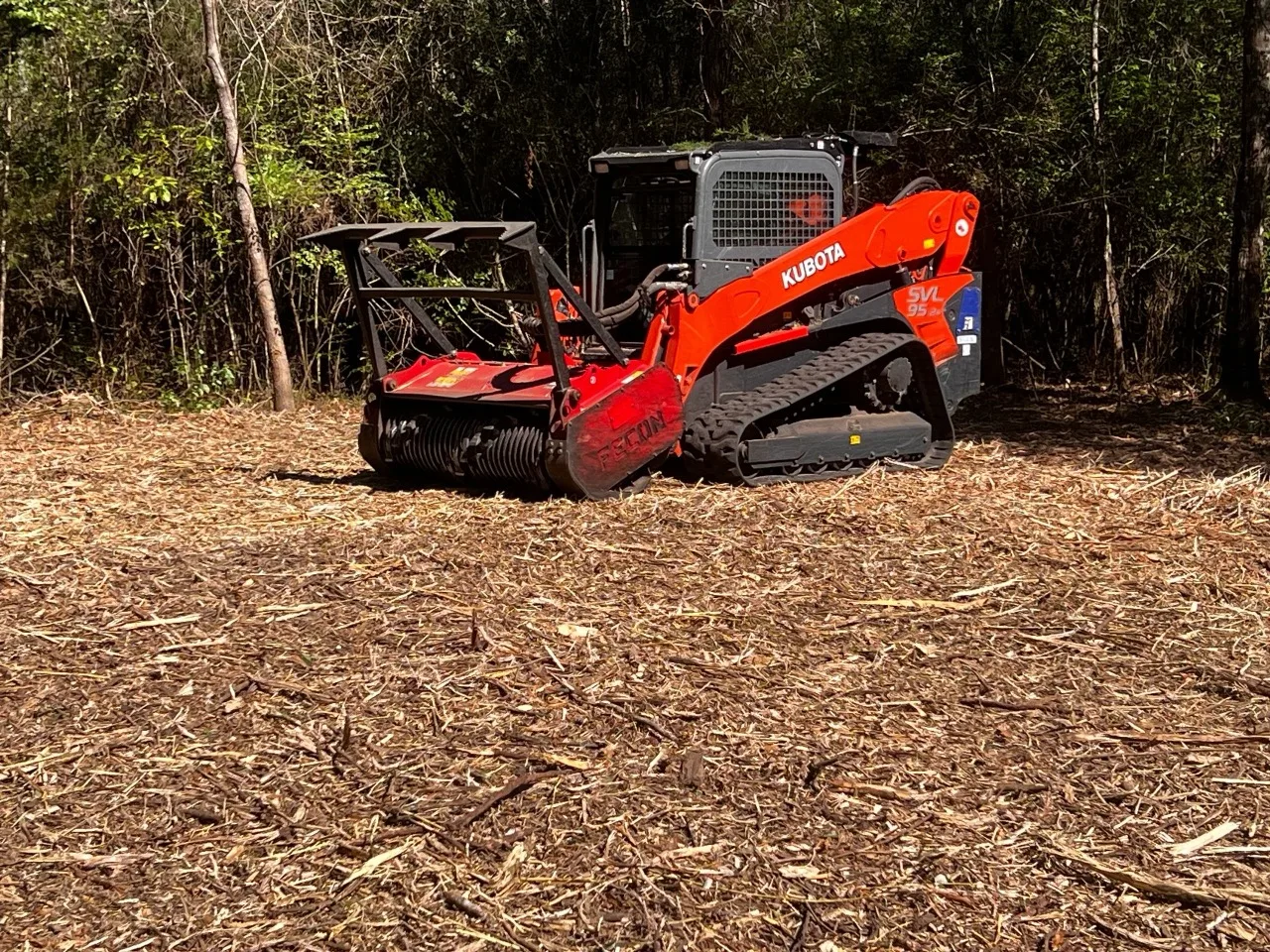
The work is done by a mulching head, a steel drum or disc fitted with teeth that spins fast enough to grind wood. That head runs on a skid steer, a compact track loader, or an excavator, and on bigger jobs a dedicated forestry mulcher. The operator drives over the growth and grinds it down in a single pass, cutting and mulching at the same time.
Most machines handle brush and trees up to about 8 to 10 inches across, and heavy-duty heads push to 12 to 15 inches. Anything bigger gets cut and removed the traditional way. Because the material stays on site as mulch, there is no debris to haul off and no burn pile to permit.
Here is a quick way to tell what fits the machine and what does not:
| What you are clearing | A good fit for mulching? |
|---|---|
| Brush, vines, and tangled understory | Yes, this is what it does best |
| Saplings and trees up to about 8–10 inches | Yes |
| Trees 12–15 inches | Heavy-duty machine only |
| Mature timber over 15 inches | No, needs tree removal |
| Stumps and roots for a building pad | No, needs grinding or grubbing |
What forestry mulching is good for
Mulching shines anywhere the goal is to clean up, open up, or maintain land rather than build on it:
- Clearing underbrush, overgrowth, and tangled understory
- Knocking back the invasive and nuisance brush that takes over local land
- Cutting trails, access lanes, and fence lines
- Reclaiming overgrown pasture, fields, and idle acreage
- Opening up hunting land and putting in food plots
- Selective clearing that leaves the mature trees you want to keep
- Cutting wildfire fuel back from a home or structure
Clearing the brush that takes over land around Houston
This is where mulching earns its keep here. Land north of Houston does not stay open on its own. Left alone, the understory fills in fast with brush that crowds out grass and swallows usable ground, and a mulcher is the quickest way to take it back.
Yaupon is the big one. It is native to East Texas, but it forms dense thickets that reduce the grasses and forbs underneath, and Texas A&M research has tracked yaupon density climbing across the region as fire has been kept off the land. On top of the natives, two imported invasives have spread through Southeast Texas: Chinese tallow, the popcorn tree, which the Texas A&M Forest Service reports grew about 38% in East Texas between 2007 and 2017 and thrives on exactly the flat, unmanaged ground we have here, and Chinese privet, a thicket-forming shrub that can take over a forest understory completely. A mulcher grinds all of it in place in one pass, which beats cutting and hauling it load by load.
The benefits of mulching over burning and hauling
- The mulch layer holds the soil and controls erosion, which matters on slopes and near water
- Ground-up material breaks down and feeds the soil instead of leaving bare dirt
- No burning means no burn permit, no smoke, and no risk during a county burn ban
- Nothing gets hauled off, so there are no dump trips or debris piles
- It disturbs the ground far less than a dozer, so you keep your topsoil
- It clears selectively, around the trees and features you want to protect
When forestry mulching is not the right call
Mulching is not the answer for every job, and a straight contractor will tell you so. It is the wrong tool when you need bare, stable ground.
For a building pad or foundation, the lot has to be grubbed and graded to strip the roots and organic matter so it compacts and drains. Mulching leaves both behind. If the stumps and roots have to be gone for a build or a replant, that is a stump grinding or removal step on its own. And any timber past roughly 12 to 15 inches is a job for our tree removal crew, not the mulcher. Very wet clay can also limit the work until the ground dries out.
If you want the full cost picture or you are weighing methods, see forestry mulching cost per acre and forestry mulching vs. traditional land clearing.
FAQ
What is forestry mulching? Forestry mulching is a land-clearing method that uses one machine to grind standing brush, vines, and small trees into mulch right where they grow. It clears in a single pass, leaves the chips on the ground as cover, and skips the burning and hauling that traditional clearing needs.
How is forestry mulching different from regular land clearing? Traditional clearing cuts the growth, then piles and hauls or burns it, often with several machines, and can strip the lot to bare dirt. Mulching does it in one pass and leaves a mulch layer behind. It is faster and lower-impact for brush and small trees, but it does not give you bare, build-ready ground.
What size trees can a forestry mulcher handle? Most mulchers grind brush and trees up to about 8 to 10 inches across efficiently, and heavy-duty machines reach 12 to 15 inches. Bigger pines and hardwoods get felled and removed separately. That makes mulching a great fit for the understory and young growth that take over land here.
Does forestry mulching prevent regrowth? It slows regrowth, it does not stop it for good. The mulch layer shades the soil and holds back weeds, and grinding below the crown sets many plants back. Aggressive growth like yaupon and Chinese tallow comes back, so land that has to stay open is best kept that way with a follow-up pass every few years.
Will grass grow after forestry mulching? Yes, in time. The mulch layer breaks down and feeds the soil, and grass and groundcover come in as it thins, especially once sunlight reaches the ground. If you want pasture or turf quickly, the chips can be raked out or the area seeded after mulching.
Does forestry mulching leave stumps? It grinds stumps down to a few inches and leaves the roots in the ground. That is fine for land you are reclaiming or keeping clear. If you need the stumps and roots gone, for a build or to replant, that is a separate stump grinding or removal step.
Is forestry mulching good for the environment? For most jobs, yes. It keeps the topsoil intact, returns the ground-up material to the soil as mulch, controls erosion, and skips burning and hauling. It is one of the lower-impact ways to clear brush and reclaim overgrown land.
See if mulching fits your land
The best way to know whether mulching is right for your property is to have someone walk it with you. MTM Land Clearing Services mulches and clears land across Spring, Conroe, The Woodlands, and the north Houston area. Tell us what you are trying to do with the land and we will give you a straight answer and a written free estimate.