
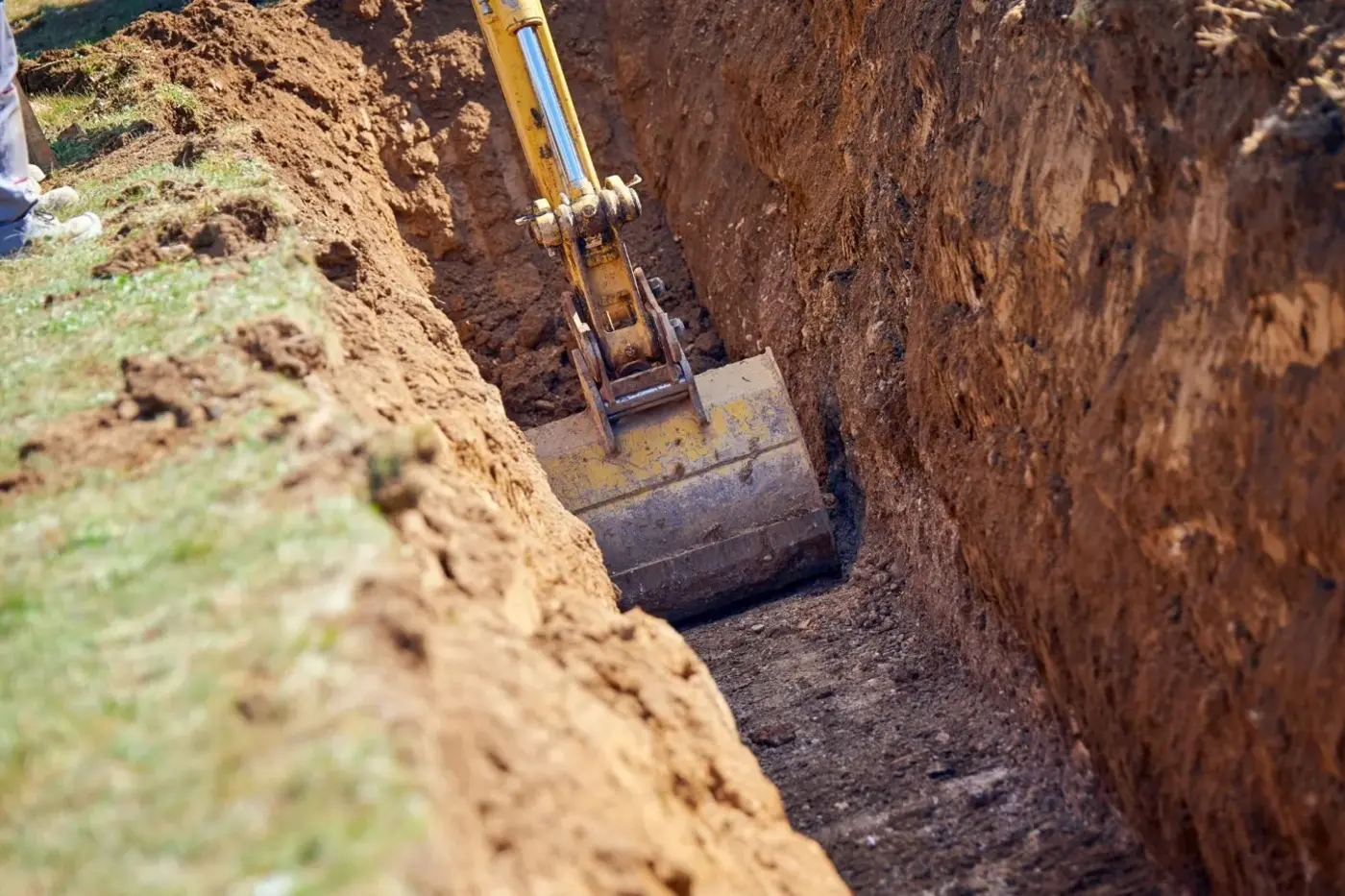
What is trenching, and how is it different from excavation?
Trenching is digging a long, narrow cut in the ground to hold a line or a footing. OSHA defines a trench as a narrow excavation, in relation to its length, made below the surface of the ground. Every trench is an excavation, but not every excavation is a trench.
What is the difference between trenching and excavation?
Excavation is the broad word, and a trench is one narrow kind of it. OSHA defines an excavation as any man-made cut, cavity, trench or depression formed by earth removal. A trench is narrow for its length. In general it is deeper than it is wide, and its bottom is no wider than 15 feet.
A wide dig for a building pad or a foundation is excavation but not a trench. A narrow run for a water line, an electric line or a footing is both.
At MTM Land Clearing Services, our trenching services cover the narrow runs dug for utility lines, drainage lines and footings. Wider digs for pads and foundations fall under our excavation work.
What are trenches dug for on a home or acreage?
On a home, homesite or acreage, trenches carry the buried parts of the build. Water, sewer, electric and gas runs go in trenches. So do drainage lines, downspout runs, footings and grade beams. HomeGuide calls drainage issues one of the most common reasons for trenching around a home or yard.
- Water and sewer: water lines from the meter or a well pump. Sewer lines run to a septic tank or the public sewer.
- Electric: underground service and runs to a detached shop, a pool or a hot tub.
- Gas: a new gas line, such as one to a whole-home standby generator. HomeGuide says those generators need trenching for a gas line and electrical conduit.
- Drainage: drainage lines and downspout runs that carry water away from the house.
- Footings and grade beams: trenches cut to the dimensions on the builder’s or engineer’s plans.
On acreage the runs get longer, since the house, the well, the barn and the meter can sit far apart.
The trench is the path, and the line belongs to a licensed trade. The plumber, electrician or utility lays the line, makes the connection and handles its permit. HomeGuide notes that most electricians do not dig trenches themselves. They hire out the digging and do the wiring.
How does a trench get dug?
A residential trench gets dug by shovel, by trencher or by mini excavator. HomeGuide notes that a trencher or mini excavator takes far less time than hand digging. MTM digs with a mini excavator. Directional boring is a separate trade’s work, used where a trench cannot open the ground, such as under a driveway.
Walk-behind and ride-on chain trenchers are rental machines that other contractors use for narrow runs. HomeGuide’s list of questions for a trenching contractor even asks whether they own or rent the trencher. A mini excavator digs the run and sets the spoil beside it, ready to go back in.
Directional boring drills a path underground instead of opening one. HomeGuide says it lets contractors drill an underground borehole beneath obstacles like concrete or pavement. That work belongs to a boring contractor.
| Method | What it is | Typical use | Who does it |
|---|---|---|---|
| Trenching | A narrow cut, usually deeper than it is wide, no wider than 15 feet at the bottom | Water, sewer, electric and gas runs, drainage lines, footings | A site-work contractor digs it, and the licensed trade lays the line |
| Excavation | Any man-made cut, cavity or depression formed by removing earth | Building pads, foundation digs, earthmoving | An excavation contractor |
| Directional boring | A borehole drilled underground beneath obstacles | Crossing under concrete or pavement without opening it | A boring contractor, a separate trade |
How deep do trenches go, and what does OSHA require?
HomeGuide says most residential trenches are less than 5 feet deep, and the depth depends on the purpose. Five feet is also where OSHA’s rules for crews change. From that depth down, a trench needs a protective system unless the excavation is made entirely in stable rock.
The rest of OSHA’s core trench rules, from its fact sheet and its excavation standard:
- Under 5 feet: a competent person may decide no protective system is needed. OSHA’s competent person can spot hazards on the site and has the authority to fix them quickly.
- 20 feet or deeper: a registered professional engineer designs the protective system. It can also be built from tabulated data, meaning tables and charts an engineer approved.
- 4 feet or deeper: a stairway, ladder, ramp or other safe way out sits within 25 feet of lateral travel.
- Spoil and equipment: kept at least 2 feet back from the edge, so nothing falls or rolls in.
- Inspections: at the start of each shift and after a rainstorm or other water intrusion.
OSHA’s protective systems include sloping and shielding along with support systems such as shoring. Sloping cuts the walls back so they lean away from the trench. The angle varies with the soil type. Shoring braces the walls with aluminum hydraulic or other supports. Shielding puts workers inside a trench box, which can be portable and moved along as the work goes.
These are OSHA’s rules for crews at work. If you are a homeowner, never step down into a deep trench, even to look at a line. OSHA defines a cave-in as soil falling or sliding in, in enough quantity to bury or immobilize a person.
Do you need to call 811 or get a permit before trenching?
Call 811 first, then answer the permit question. Texas law requires notice to the one-call center at least 48 hours before an excavation begins. Every trench is an excavation. Permits depend on the parcel and the line. HomeGuide notes that digging a trench requires a permit in some cities.
The line’s permit belongs to the licensed trade that lays it. Site work around the trench, such as clearing or grading, can add county rules. Our Montgomery County permit guide and Harris County permit guide cover the development permit side. The team checks what the parcel needs during the free estimate.
How is a trench backfilled, and why can the line settle?
After the line is laid, the trench gets backfilled and compacted. Loose fill settles, and water speeds that up. A University of Houston construction spec places trench backfill in layers no deeper than 8 inches loose. Each layer is compacted to at least 95 percent of the soil’s standard maximum density.
Settling is what those rules guard against. The same spec tells contractors to protect structures, sidewalks and pavements from damage caused by settlement. It also has improperly compacted trenches reopened, refilled and compacted again.
Water settles trench soil. The Arizona Municipal Water Users Association’s irrigation guide has homeowners backfill a trench halfway. Then it says to fill it with water to settle the soil. Left loose, a trench line can sink after heavy rain and leave a low strip across the yard.
We backfill, compact and rough-grade the run once the line is in. When the yard or pad around it needs reshaping too, that falls under our grading and dirt work.
How much does trenching cost per foot?
HomeGuide puts the average cost to dig a trench at $5 to $12 per linear foot. Labor runs $3 to $9 of that, and the equipment or trencher $2 to $3. Homewyse’s national average starts at $11.55 to $27.48 per linear foot. These are published market ranges.
Installed project prices include the line and its installation too. HomeGuide’s per-foot ranges for complete projects, trenching included:
- Drainage system: $10 to $30 per linear foot
- Water line: $30 to $50 per linear foot
- Electrical run (HomeGuide’s electrical panel row): $6 to $14 per linear foot
Length comes first, then depth. HomeGuide says trenching costs more in hard clay or rocky soil, and soil moisture matters as well. Access matters too. HomeGuide notes that a gas line trench costs more when it crosses a driveway, sidewalk or other obstacles. Trees, stumps or rock in the path add cost.
Restoration and spoil haul-off finish the list. HomeGuide’s questions for a trenching contractor include what happens to the excavated dirt and whether the estimate includes site cleanup. Ask both before the work starts.
How does MTM handle trenching?
We dig the trench with a mini excavator, to the depth and route on the trade’s plan. Then the licensed plumber, electrician or utility lays the line and makes the connection. Once the line is in, we backfill, compact and rough-grade the run. Each trade does its own part.
If the route crosses brush or woods, a compact track loader with a forestry mulching head clears a lane first. Spoil that does not go back in leaves by truck or roll-off container.
Open trenching often comes inside a bigger job. On a new homesite, the utility trenches usually follow the clearing and pad work from our site preparation service. Our guide to clearing a wooded lot to build covers the steps before the first trench.
MTM digs and backfills trench runs around Spring, Montgomery County and north Houston, and we are fully insured. Call (281) 432-7360 or request a free estimate.